
The Anglo-Saxon Chronicle is not one work but a family of manuscripts, each descending by its own route from the annals compiled in King Alfred’s reign. The diagram below, drawn by Simon Keynes in November 2015, reconstructs that development; the cards beneath it set out the stages, the blocks of annals and the surviving manuscripts.
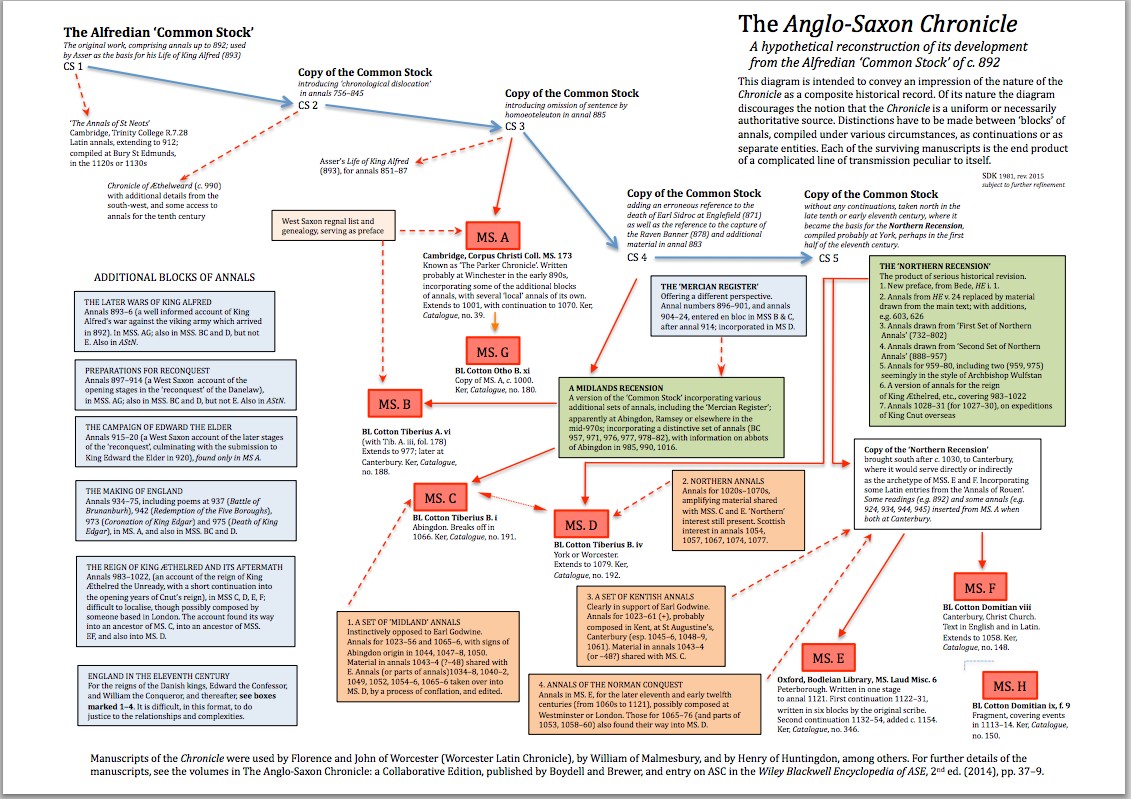 Simon Keynes, The Anglo-Saxon Chronicle: a hypothetical reconstruction of its development from the Alfredian ‘Common Stock’ of c. 892 (November 2015). Click to zoom.
A composite historical record
“Distinctions have to be made between ‘blocks’ of annals, compiled under various circumstances, as continuations or as separate entities. Each of the surviving manuscripts is the end product of a complicated line of transmission peculiar to itself.”

From the Common Stock
The stages of copying that the diagram reconstructs between Alfred’s original compilation and the surviving manuscripts.
The original work, comprising annals up to 892; used by Asser as the basis for his Life of King Alfred (893).
Copy of the Common Stock introducing ‘chronological dislocation’ in annals 756–845.
Copy of the Common Stock introducing the omission of a sentence by homoeoteleuton in annal 885.
Copy of the Common Stock adding an erroneous reference to the death of Earl Sidroc at Englefield (871), the reference to the capture of the Raven Banner (878), and additional material in annal 883.
Copy of the Common Stock without any continuations, taken north in the late tenth or early eleventh century, where it became the basis for the Northern Recension, compiled probably at York, perhaps in the first half of the eleventh century.
A further copy of the Common Stock, standing behind the Midlands recension and the later manuscripts.
Blocks of annals
The additional blocks that the diagram distinguishes after 892, with the manuscripts in which each survives.
The later wars of King Alfred
A well-informed account of King Alfred’s war against the viking army which arrived in 892.
Also in the Annals of St Neots; not in E.
Preparations for reconquest
A West Saxon account of the opening stages in the ‘reconquest’ of the Danelaw.
Also in the Annals of St Neots; not in E.
The campaign of Edward the Elder
A West Saxon account of the later stages of the ‘reconquest’, culminating with the submission to King Edward the Elder in 920.
Found only in MS. A.
The making of England
Including the poems at 937 (the Battle of Brunanburh), 942 (the Redemption of the Five Boroughs), 973 (the Coronation of King Edgar) and 975 (the Death of King Edgar).
The reign of King Æthelred and its aftermath
An account of the reign of King Æthelred the Unready, with a short continuation into the opening years of Cnut’s reign; difficult to localise, though possibly composed by someone based in London. It found its way into an ancestor of MS. C, into an ancestor of MSS. E and F, and also into MS. D.
England in the eleventh century
The reigns of the Danish kings, Edward the Confessor and William the Conqueror, and thereafter: separate continuations in the several manuscripts, whose relationships are too complex to reduce to a single line.
The manuscripts
The eight surviving witnesses, lettered A to H as in the editions. Each is the end product of its own line of transmission.
The Parker (or Winchester) Chronicle
Written at Winchester from the 890s, continued at intervals to the mid eleventh century, then at Canterbury
The oldest manuscript: the Common Stock in a hand of c. 900, with the blocks for 893–920 and 934–75 added as they were composed. Later at Christ Church, Canterbury, where the Norman-era additions were made.
The Abingdon Chronicle I
Late tenth century (c. 977–1000), probably at Abingdon
A copy ending at 977, closely related to C; both derive from a common exemplar with the Mercian Register of the years 902–24 inserted.
The Abingdon Chronicle II
Mid eleventh century, Abingdon
Carries the annals to 1066, including the account of Æthelred’s reign and a vivid record of the years of Cnut, Edward the Confessor and the events of 1066.
The Worcester Chronicle
Mid eleventh century, with a northern and a Worcester background
The Northern Recension combined with the southern blocks; continued to 1079, with much material on the north and on the Scots.
The Peterborough Chronicle
Peterborough, copied in 1121 and continued to 1154
The latest of the manuscripts, copied at Peterborough from a Canterbury exemplar and continued there through the reign of Stephen; the last entries are among the earliest Middle English.
The bilingual Canterbury epitome
Christ Church, Canterbury, c. 1100
An abridgement in Old English and Latin made from the Canterbury exemplar that also lies behind E.
The copy of A
Eleventh century, Winchester
A transcript of A made before the Canterbury additions; badly damaged in the Cotton fire of 1731 and known largely from a sixteenth-century transcript.
The Cottonian fragment
Twelfth century
A single leaf with annals for 1113–14, from a lost manuscript.
Related works
Asser’s Life of King Alfred (893)
Draws on the Common Stock for the annals 851–87.
The Chronicle of Æthelweard (c. 990)
A Latin version by the ealdorman Æthelweard, with additional details from the south-west and some access to annals for the tenth century.
The Annals of St Neots
Cambridge, Trinity College R.7.28: Latin annals extending to 912, compiled at Bury St Edmunds in the 1120s or 1130s from a lost manuscript of the Chronicle.
The Northern Recension
Compiled probably at York in the first half of the eleventh century from a copy of the Common Stock without continuations; the basis of MS. D and, through Canterbury, of E and F.
Later users
Manuscripts of the Chronicle were used by Florence and John of Worcester (the Worcester Latin Chronicle), by William of Malmesbury and by Henry of Huntingdon, among others.
Further reading and texts
The Anglo-Saxon Chronicle: a Collaborative Edition
Published by Boydell and Brewer (general editors David Dumville and Simon Keynes), one volume per manuscript, with full introductions to each.
The Wiley Blackwell Encyclopedia of Anglo-Saxon England
2nd ed. (2014), pp. 37–9, the entry on the Chronicle.
The texts online
Tony Jebson’s XML edition gives the Old English text of each manuscript, annal by annal.